Just Swim
Why do we need to consider breast health in aquatic sports?
11/06/2025The diversity of aquatic sports entails lots of different movements, training and interactions both in and out of the pool.
This motion and potential for breast discomfort means that breast support is required, potentially minimising breast injury and helping to maintain or improve performance.
This resource, developed by Rebecca Grant PhD, Senior Lecturer in Human Factors Metrology, and Lauren Holmes, PhD Researcher in breast measurement, focuses on breast health specifically in aquatic sports.
It explores why and how the breast is supported and how to achieve this effectively through sports bra selection for different competitive and training scenarios.
How is a breast supported?
The breast is composed of a mix of glandular tissues, fatty tissues, connective tissues and milk ducts, and is a mass that projects from the chest wall, predominantly supported by the skin.
The skin and breast tissue can experience increased strain and shape change when moving and exercising, causing pain and discomfort during exercise.
How does a breast move in water?
To consider the movement of the breast in water, we can break this into movement types experienced across all aquatic disciplines – artistic swimming, diving, swimming and water polo.
All sports include swimming through water, with swimming and artistic swimming having turns and tumbling underwater. In addition, these classifications along with diving, experience water entry impacts and water polo typically has more upright aerobic movements.
Team based aquatic sports also have an additional risk of Contact Breast Injury (CBI) due to close movement to other athletes, already reported amongst female water polo players (5). These movement groups can be used to consider breast health and support requirements.
Buoyancy experienced due to the relative density of water and breast tissue can provide a more ‘natural support’ and reduced discomfort from lower skin strain experienced by the breast mass position in upright movements.
Initial research indicates that there is no significant difference in total breast range of motion in and out of the water when wearing a swimsuit or sports bra during jumping movements (4). However, when swimming through water and turning, breast size is likely to impact comfort, with larger breast volumes contributing to feelings of imbalance as they are more likely to move out of phase with the body.
Other research has explored trunk and breast movement, recommending more support is needed in swimwear for larger breast sizes (6). To increase breast support when swimming, thicker swimming costumes straps that distribute the weight across shoulders will reduce strain and wearing a costume that covers a larger surface area, with a higher neckline that limits gaping, will help to hold the breast against the body across different swimming, turning and upright movements. Wide straps and larger surface area covered is also true for land-based gym exercises for those with larger breast size (7).
What impact does diving have on breasts?
This is a difficult question to answer a sit is reliant on many factors such as breast mass, skin elasticity, position and speed the water is entered.
More research is needed to further explore this implication, but if simplified, the greater the mass, the greater the force experienced. This may then be a question of technique and entry into the water to minimise the impact felt on the chest upon entry.
If diving frequently and from greater heights – where the chest experiences the most force upon water entry (9) – have a discussion with a medical professional if you do experience any pain, redness or bruising across the top of your breast. It is always better to have greater awareness and report any symptoms of discomfort early.
Contact Breast Injuries (CBIs)
As the focus on women in sport grows, the discussion of injuries and discomfort experienced during exercise is becoming more commonplace, providing greater opportunity to identify the extent of injury in specific sports (10).
A CBI occurs when the breast is hit with a blunt force (11), which could be knocks from other athletes, or collision with sports equipment or a hard surface (12,13). This has already been shown in American water polo, with half of female water polo players experiencing CBIs during play and training, however, none had reported this to a medical professional (13).
Breast injuries sustained can lead to the development of a fatty lump in the breast tissue, which is often mistaken for breast cancer (14) or mastitis which can lead to an abscess (15), or pain, swelling and bruising – all of which can negatively impact engagement in sport.
It has been noted that even though there is no easy way to avoid an injury when it occurs, better injury awareness leads to better reporting and treatment (10), something to echo through all aquatic sports.
Other non-contact breast injuries can occur, such as friction-based injuries. However, these are far less prevalent in aquatic sports, so are not covered here.
How can a good sports bra help me?
(1). A bra can help to support this breast mass to reduce strain and discomfort through everyday movements, and a sports bra often provides additional coverage to help contain the breast during increased movement experienced during exercise (2).
Sports bras are often classified into ‘compression’, ‘encapsulation’ or a hybrid of these two, and hold the breasts closer to the chest wall, hold the breasts separately or a mix of both respectively, to reduce breast motion during exercise (3).
A swimming costume holds and supports the breasts similarly to a sports bra, with the difference being whole body design, rather than a separate top. Research has shown a sports bra and swimming costume perform similarly to support moving breast tissue (4).
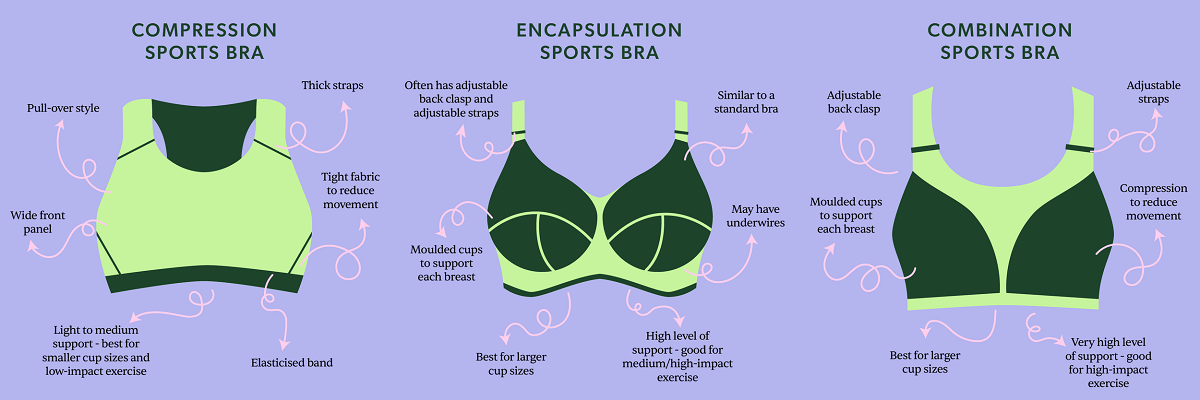
Image credit: big-sister.co.uk
It is important to note that aquatic athletes should seek support for their chests both in and out of the water, as strength and conditioning training completed on land also requires breast support to facilitate exercise.
There is no one size that fits all, as there are so many factors that contribute to the size and fit of a sports bra to maximise performance. A bad fit can have a significant impact on performance (16), reducing breathing ability (17) and running biomechanics (18), so it is important to try on different designs to work out how a bra can help you train at your best.
Some considerations of what to look for are outlined below, but it is important to note that these can vary depending on breast size and the movement you are completing, so try before you buy, and complete some example movements in a fitting room to ensure you don’t have any surprises later on. A lot of these principles can also apply to swimming costumes, to encourage support in the water too.
Choosing support or impact level
This relates to the type of movement and intensity, as well as the breast size needed to provide support.
- Consider the stiffness of the bra you are wearing – often stiffer panels or areas of stiffer material across the top and sides of the breast help to restrict movement during vigorous exercise.
- Test out arm movement to ensure you can complete the technique or motions unrestricted. Some stiffer bras can feel more restrictive across pectoral muscles, so ensure these are not impacting performance or causing chafing. Consider a larger size or adjusting straps if this is experienced. When testing movements, check if you can feel seams and stitching when you move. These can cause rubbing and chafing, so looking for seamless options could be a better alternative.
- Ensure you have good surface area coverage of the breast to enable effective support. This often means a higher neckline, but again, test different movements to check for a gaping neckline.
Fit
Lots of size guides and reading materials exist for sports bra fit, and how to adjust for your size and body shape. Here are some examples of what to consider:
- Check your under band is not too tight – it is sometimes tempting to get a smaller under band or size to increase feelings of compression to feel more secure and ‘held in place’, but in reality, this will restrict breathing, whole body movement, and you will end up fiddling with the bra more. Consider a wider under band to reduce the force felt across the ribcage and ensure this is not sat in your inframammary fold. If so, you need to adjust the straps and consider how much adjustability you have on the under band if it has a clasp system – if on the highest or lowest clasp, you could try a different under band size.
- Adjustability of straps is important to better suit torso length. Ensuring you can adjust the bra and have room for growth adjustment is important. Avoid spaghetti straps, as these will be unlikely to provide any support for breasts during movement and exercise. If you are larger chested c try and buy a bra with thicker straps, this will reduce discomfort on your shoulders.
- Check the cups – bras often come with molded cup inserts, which can provide a bit of extra support in some cases. If you are smaller chested, check that a molded cup fits the shape of your breast, and doesn’t cause empty space and therefore reduces support – remove these and see how the shape changes. Larger chested women will likely feel benefit from a cup insert, and additional support bands can be found on some specialist sports bras that run over the top of the cup, to further dampen movement.
Material choices
- A moisture-wicking material will likely improve comfort during exercise, to keep the bra feeling lighter on your body, and you feeling fresher and cooler. Look at the fabric composition of sports bras, typically synthetic options will perform better for sweat wicking. Cotton or cotton blends are absorbent, so will collect sweat over time and feel heavier through a training session.
- Some bras contain a breathable panel at the front under band face of the bra, between the breasts. This area of the torso gets warmer through exercise and does not experience the same air flow as other parts of the body, so this could help with minimizing discomfort.
Should I wear a sports bra in the water?
A swimming costume acts similarly to a sports bra, so ensure you have good chest coverage, and you feel supported when engaging in aquatic sports.
If you feel you require extra support, or additional protection around breast impacts, whether these are from water entry or contract with others or equipment, then a sports bra may benefit.
More development and research is needed for breast support in and around swimwear, but if you do want to wear one in the water, look for one with a similar material composition to swim wear, avoiding higher amounts of cotton or other absorbent materials that will add weight in the water. Make sure the neckline sits well against your chest so it doesn’t gape, and that you can still move comfortably through various exercises.
References
- McGhee, D. E., & Steele, J. R. (2020). Breast biomechanics: what do we really know? Physiology.
- McGhee, D. E., & Steele, J. R. (2020). Biomechanics of breast support for active women. Exercise and sport sciences reviews, 48(3), 99-109.
- Brown N, White J, Brasher A, Scurr J. (2014). An investigation into breast support and sports bra use in female runners of the 2012 London Marathon. Journal of Sports Sciences, 32(9):801-809.
- Mills C, Ayres B, Scurr J. (2015) Breast Support Garments are Ineffective at Reducing Breast Motion During an Aqua Aerobics Jumping Exercise. Journal of Human Kinetics, 46:49-58. doi: 10.1515/hukin-2015-0033. PMID: 26240648; PMCID: PMC4519221.
- Bibby, K., Kenny, I.C., Cahalan, R. et al. (2024) Contact Breast Injuries Among Female Athletes: A Systematic Review. Sports Medicine 54, 1921–1930 doi: https://doi.org/10.1007/s40279-024-02027-y
- Mills, C., Lomax, M., Ayres, B., & Scurr, J. (2014). The movement of the trunk and breast during front crawl and breaststroke swimming. Journal of Sports Sciences, 33(4), 427–436. Doi: https://doi.org/10.1080/02640414.2014.946951
- Ocran, F. M., Ji, X., & Zhai, L. (2022). A study to evaluate pressure distribution of different sports bras. Journal of Engineered Fibers and Fabrics, 17, 15589250221118643.
- Harrison, S. M., Cohen, R. C., Cleary, P. W., Barris, S., & Rose, G. (2012, December). Forces on the body during elite competitive platform diving. In Ninth International Conference on CFD in the Minerals and Process Industries (pp. 10-12). CSIRO.
- Rubin, B. D. (1999). The basics of competitive diving and its injuries. Clinics in sports medicine, 18(2), 293-303.
- Ekegren CL, Gabbe BJ, Finch CF. (2016) Sports injury surveillance systems: a review of methods and data quality. Sports Medicine, 46:49–65.
- Obourn PJ, Benoit J, Brady G, Campbell E, Rizzone K. (2021). Sports medicine-related breast and chest conditions—update of current literature. Current Sports Medicine Reports, 20:140–9.
- Brisbine BR, Steele JR, Phillips EJ, McGhee DE. (2019) The occurrence, causes and perceived performance effects of breast injuries in elite female athletes. Journal of Sports Science and Medicine, 18:569–76.
- Smith LJ, Eichelberger T, Kane EJ (2022) Breast Injury in USA Female Water Polo Athletes. International Journal of Sports and Exercise Medicine 8:216. doi.org/10.23937/2469-5718/1510216
- Daly CP, Jaeger B, Sill DS. (2008) Variable appearances of fat necrosis on breast MRI. American Journal of Roentgenology, 191: 1374–80.
- Mahoney MC, Ingram AD. (2014) Breast emergencies: types, imaging features, and management. American Journal of Roentgenology, 202: W390–9.
- Norris, M., Blackmore, T., Horler, B., & Wakefield-Scurr, J. (2021). How the characteristics of sports bras affect their performance. Ergonomics, 64(3), 410-425
- McGhee, D.E. (2009) Sports bra design and bra fit: Minimising exercise-induced breast discomfort Author: Deirdre McGhee
- Powell, D. W., Fong, H. B., & Nelson, A. K. (2023). Increasing breast support is associated with altered knee joint stiffness and contributing knee joint biomechanics during treadmill running. Frontiers in Sports and Active Living, 5, 1113952.