Just Swim

Pelvic floor health in aquatic athletes
12/05/2025Training to participate in aquatic sports involves the development of strength and functional control of all the muscles in the body, including the pelvic floor muscles.
The pelvic floor muscles are essential for both men and women and understanding their function and how to strengthen them is crucial for maintaining overall health and wellbeing.
Problems with the pelvic floor can produce a range of symptoms which can cause psychological challenges and may even result in athletes no longer participating in sport.
What is the pelvic floor?
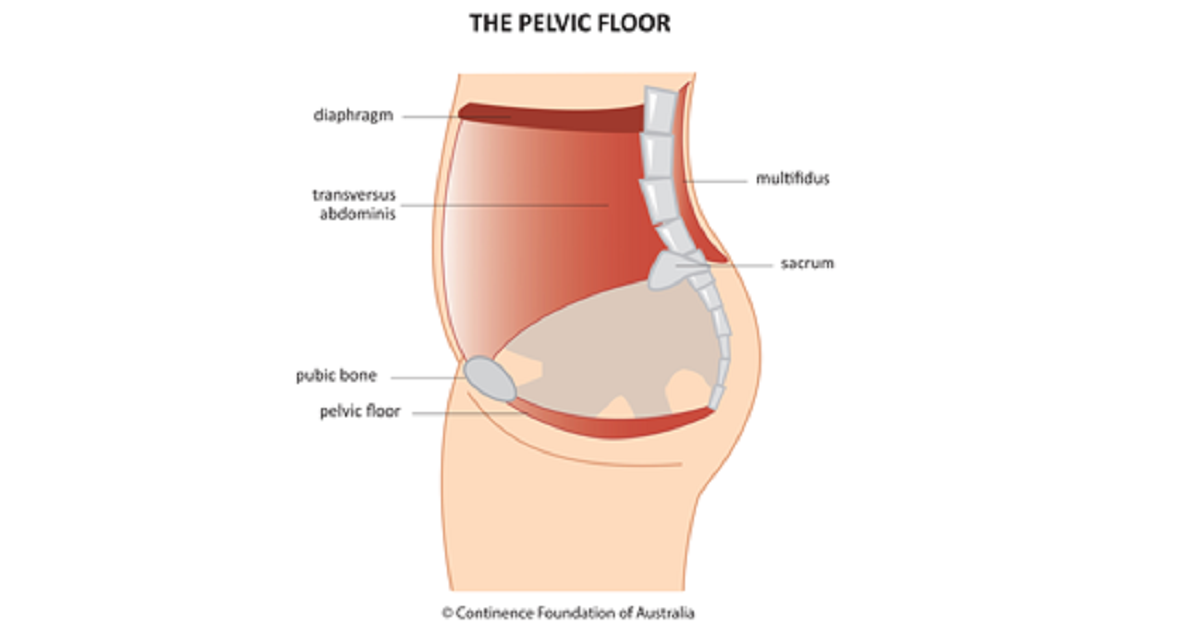
Image credit: www.pelvicfloorfirst.org.au
Imagine your core as a cylinder with the abdominal muscles at the front, spinal muscles at the back, diaphragm at the top and pelvic floor at the bottom.
The pelvic floor helps hold the abdominal contents in place from underneath and stabilizes the cylinder.
The pelvic floor consists of muscles, ligaments and connective tissues. A well-functioning pelvic floor provides good bladder control and bowel control. It allows the abdominals and spinal muscles to stabilise the spine and movements of the trunk.
Weakness of the pelvic floor muscles can cause symptoms such as leaking urine when you laugh, cough, sneeze or exercise. Overactivity of the pelvic floor muscles can also cause problems with frequency of urination and pelvic pain.
The pelvic floor muscles need to be strong enough to work against the increased pressure within the abdomen and engagement or switching on needs to be co-ordinated with the other abdominal muscles. Sporting activities often involve more strength and power from the abdominal muscles, therefore more pelvic floor engagement is required.
The pelvic floor needs to be switched on before the abdominal muscles contract and intra-abdominal pressure increases.
The symptoms mentioned above can be from the pelvic floor not being strong enough or mistiming of muscle engagement, however, overworking during sport and daily activities or being unable to switch off and relax when resting can also cause problems.
How common are pelvic floor problems?
Urinary incontinence is not uncommon during exercise and the number of athletes experiencing problems increases with the level of impact of the activity. On average 25-45 per cent of female athletes report leaking of urine during training or a competition. Up to 80 per cent of trampolinists experience problems.
It is found in both male and female athletes but is three to five times more prevalent in women and can be in younger and older athletes.

Signs and symptoms of pelvic floor problems
There can be issues with any part of the pelvic floor anatomy including the bladder, vagina and bowel. All these problems may be referred to as Pelvic Floor Dysfunction (PFD).
Pelvic floor problems may be associated with weakness (hypotonic) or overactivity (hypertonic) of the pelvic floor muscles.
Pelvic floor weakness
The most common complaint of all pelvic floor dysfunction is incontinence.
Urinary Incontinence (UI) – This is the involuntary loss of urine and there are two main types of (UI). The first of these is tress urinary incontinence (SUI) which is the involuntary loss of urine during effort in sport or physical exertion, or on sneezing or coughing. The second is urgency urinary incontinence (UUI) which is the involuntary loss of urine associated with urgency or needing the toilet.
Symptoms of weakness
- Increased frequency of urination
- Leaking of urine during training or with coughing, laughing or sneezing
- Needing to rush to the toilet
- Dragging or heavy feeling in the vagina or prolapse of the pelvic organs
- Bowel issues
- Incontinence of urine or feces
Other PFD symptoms
- Dragging or heavy feeling in the vagina or prolapse of the pelvic organs
- Bowel issues
- Sexual dysfunction
Symptoms of overactivity
- Muscle pain of the internal or external muscles
- Difficulty initiating or maintaining urination
- Constipation
- Straining during bowel movements
- Painful sex
In addition to the effect on the function of the pelvic organs, the pelvic floor is the base of the core, therefore weakness can result in poor core stability, which is required for posture, balance, coordination and daily activities.
Poor core stability can contribute to lower back pain and other joint and muscle problems.
This happens because as the body moves, energy is transferred through the body along the kinetic chain. Poor pelvic floor function can affect this energy transfer through the chain and ultimately affect sport specific movements and performance.
Causes / risk factors – general population and athletes
In aquatics, take-off particularly from a springboard increases the risk of weakness in the pelvic floor from repeated loading. The risk of Pelvic Floor Dysfunction is also increased with weightlifting and resistance work during land-based training.
Other factors that can increase incontinence issues include:
- Going to the toilet ‘just in case’ rather than when needed
- Caffeine (tea, coffee, chocolate) increases urgency
- Reducing fluid intake irritates the bladder and increases urgency
- Acid drinks – fruit juice, can impact on sensitivity
Identifying the pelvic floor
To improve the awareness of your pelvic floor, in a relaxed seated position, squeeze the muscles you would need to use to stop urination at the front or passing gas or poo at the back. These are your pelvic floor muscles!
You can try this on the toilet, but it is not a good idea to stop your flow of urine or movements as a way of strengthening the pelvic floor generally as it can cause retention problems or increase the risk of infection.
Interventions
Pelvic floor exercises are sometimes known as Kegels and can be practiced as a slow prolonged contraction to work the slower twitch muscle fibres and a quicker on and off engagement to target the fast twitch pelvic floor muscle.
It is best to start in a sitting or lying down position when learning how to practice these exercises.
Kegel exercises
Initially you should relax and gently breathe in and out from the lower ribs. The muscles in the legs and buttocks should stay relaxed when isolating the pelvic floor muscles but the lower abdominal muscles contract with the pelvic floor.
Breathe in to prepare then breathe out, gently lifting or drawing up through the vagina. Aim to hold for 10 seconds whilst taking another breath in and out then relax fully. Build up to 10 repetitions but you may need to start with a ‘little and often’ approach. As the control improves you should practice the exercise three times a day.
Once you are comfortable with contracting the pelvic floor muscles in a lying or seated position, try more challenging positions such as standing (feet close together initially), walking and performing functional activities, including adding load.
To strengthen the faster twitch fibres this contraction can be switched on and off. As with the longer contraction, initially start to practice this in sitting or lying. See if you can squeeze the pelvic floor muscles, hold for a second and release fully, making sure you are breathing normally.
Aim to be able to do 10 long squeezes, holding each squeeze for 10 seconds, followed by 10 short squeezes, three times a day.
Imagery
Contraction of the pelvic floor can also be graduated. Imagine your pelvic floor muscles as an elevator.
In a good sitting position, let everything underneath relax fully – the elevator is at the bottom. As you engage the muscles see if you can get the elevator to rise all the way to the 10th floor, hold and relax back down. Then see which floor the elevator stops at in a comes to at rest. Sitting upright with a shallow hollow in the lower back should leave the elevator resting at floor 3-5.
It is important to be able to relax the pelvic floor fully (with the elevator at the ground floor), as well as achieving a full contraction.
Ten top tips for looking after your pelvic floor in aquatic sports
- Keep the load manageable – Keep any weights you are lifting to a load you can maintain pelvic floor with. Try not to lift heavy weights that make you strain or hold your breath. Consider the number of repetitions when bouncing or jumping.
- Lift with good posture – Maintain the normal inward curve in your lower back during every lift/lower/push/pull exercise you do, regardless of whether you are sitting, standing or lying on your back.
- Use your pelvic floor muscles – Activate your pelvic floor muscles prior to and during resistance exercises or bounding/jumping. The goal is for your pelvic floor to be working immediately before and as you lift/lower/push or pull any load or movement.
- Exhale with every effort – Never hold your breath or pull your tummy in strongly during an exercise. This increases the downward pressure on your pelvic floor. Breathe out with every effort when possible.
- Keep your feet close together – You will find it easier to activate your pelvic floor muscles by keeping your feet close together. If you are performing a standing resistance exercise keep your feet no wider than hip width apart.
- Strengthen gradually – Start using light resistance and pay attention to performing the exercise correctly to reduce your risk of injury. Gradually increase your resistance when you are confident of your technique.
- Take care when fatigued or injured – Your pelvic floor and deep abdominal muscles may not work as effectively when you are tired, unwell or have lower back pain. This may make you more prone to symptoms and injury. Take a break and return to resistance training when you have recovered.
- Rest between sets – Rest for a couple of minutes between each set of exercises you perform. This gives your muscles (including your pelvic floor muscles) time to recover before your next lift.
- Avoid aggravating movements and exercises – Listen to your body when exercising. If your symptoms are worse with a specific exercise, modify it or leave it and perform another exercise to strengthen the same area instead.
- Prevention is better than cure – Try working on pelvic floor exercises to maintain a healthy pelvic floor, as well as strengthening any weakness. Use your phone to set reminders to do the exercises.
Have a look online or in the apps store for pelvic floor exercise apps.
Once you are aware of how the engagement of the pelvic floor feels, check in with yourself occasionally. Are these muscles working and by how much?
If you do have symptoms and they interfere with daily activities or seem to be getting worse, seek professional advice. Similarly, if you don’t think you are practicing the exercises correctly, they may be inappropriate or don’t seem to be helping, professional advice should be sought.
References
- Giagio S, Stracciolini A, Pillastrini P, Rial Rebullido T. BJSM (2023)
- www.pelvicfloorfirst.org.au