 Swim England
Coach Education
Coaching has changed, and the role of the coach is more complex than ever. Coaches and clubs play a vital role in shaping environments that enable people to thrive, creating positive, people‑first experiences across aquatics.
That’s why we are evolving Coach Education. This page outlines why change is needed and shares key information at this stage. Existing qualifications remain valid, with further detail to be shared in due course.
Curriculum Framework: A New Approach to Coach Education
Developing reflective, adaptive, and caring coaches equipped to meet the evolving needs and demands of contemporary coaching.
Our Coach Education Curriculum brings together our philosophy for coaching, learning principles, curriculum concepts and real-world practice to support coaches to develop their craft and expertise in coaching.
Why a new curriculum?
Coaching is complex.
It takes place in dynamic environments with complex individuals that all have specific and evolving needs and wants. Coaches are constantly making decisions, adapting to situations, and supporting people to learn, progress, and achieve their goals.
Previous approaches to coach education have positioned coaching as a simple, ordered, and technical activity. While partially useful, these approaches do not fully reflect the reality of coaching.
This curriculum is different.
It is designed to help coaches develop the expertise, judgement, and decision making to coach effectively, ethically, and successfully.
How we see coaching
We believe coaching is:
- Complex and context-dependent
- Ethical, relational and reciprocal
- A process of experimenting and learning over time
In coaching there are rarely simple answers and often multiple reasons, problems and solutions.
Coaching is a craft and a practice
Coaches respond to people and situations, figure stuff out, make informed decisions, and generate practical knowledge.
Coaches draw on experience, theory and use ideas in practice to frame and then solve complex problems where coaching happens.
How the curriculum is underpinned
The curriculum is designed around the genuine responsibilities of coaching that matter to coaches.
A simple framework for coaching
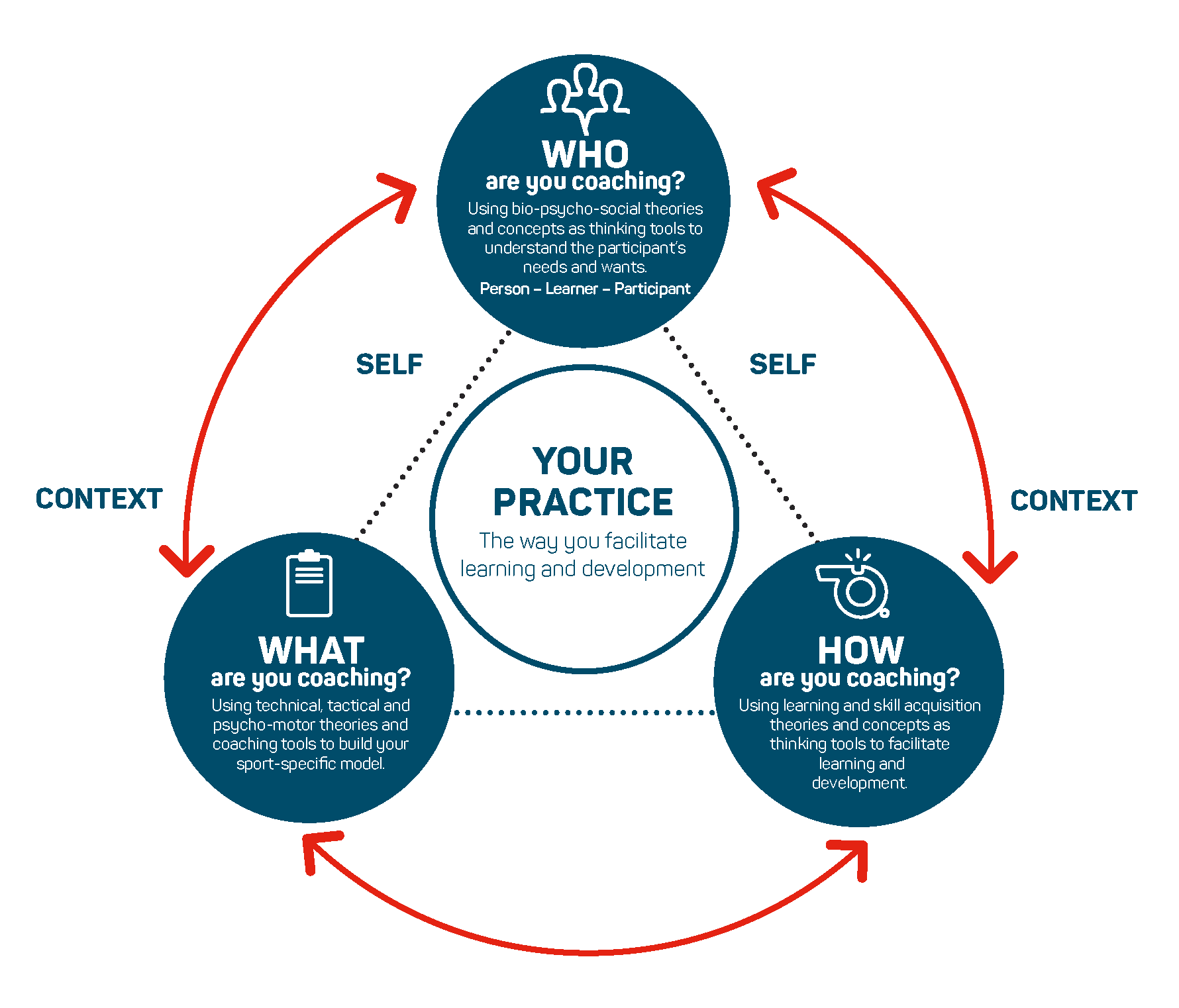
We organise learning through the Who–What–How framework:
- Who → Who are you coaching?
- What → What are you coaching?
- How → How are you coaching?
These are always connected.
Learning through experience
Coaches learn from doing coaching and reflecting on their coaching.
This means learning through:
- Real coaching situations
- Reflection on, in and for experience
- Learning conversations with other coaches
- Making sense of practice
Coaches will be continuously supported and challenged to develop their understanding of what works for who in what context and why.
Learning that builds over time
Learning in this curriculum is continuous, coherent and progressive.
We use a spiral approach, where key ideas and responsibilities are revisited over time, each time at a deeper level.
This helps coaches build:
- A realistic grounding of coaching
- Stronger understanding
- Greater confidence
- More refined decision-making
Curriculum structure
Our curriculum is based on the practical needs of coaching in Aquatics. It aims to elevate and value coaches and coaching. Each course or programme provides a person-centered, relevant and appropriate learning opportunity to support coaches to improve their practice.
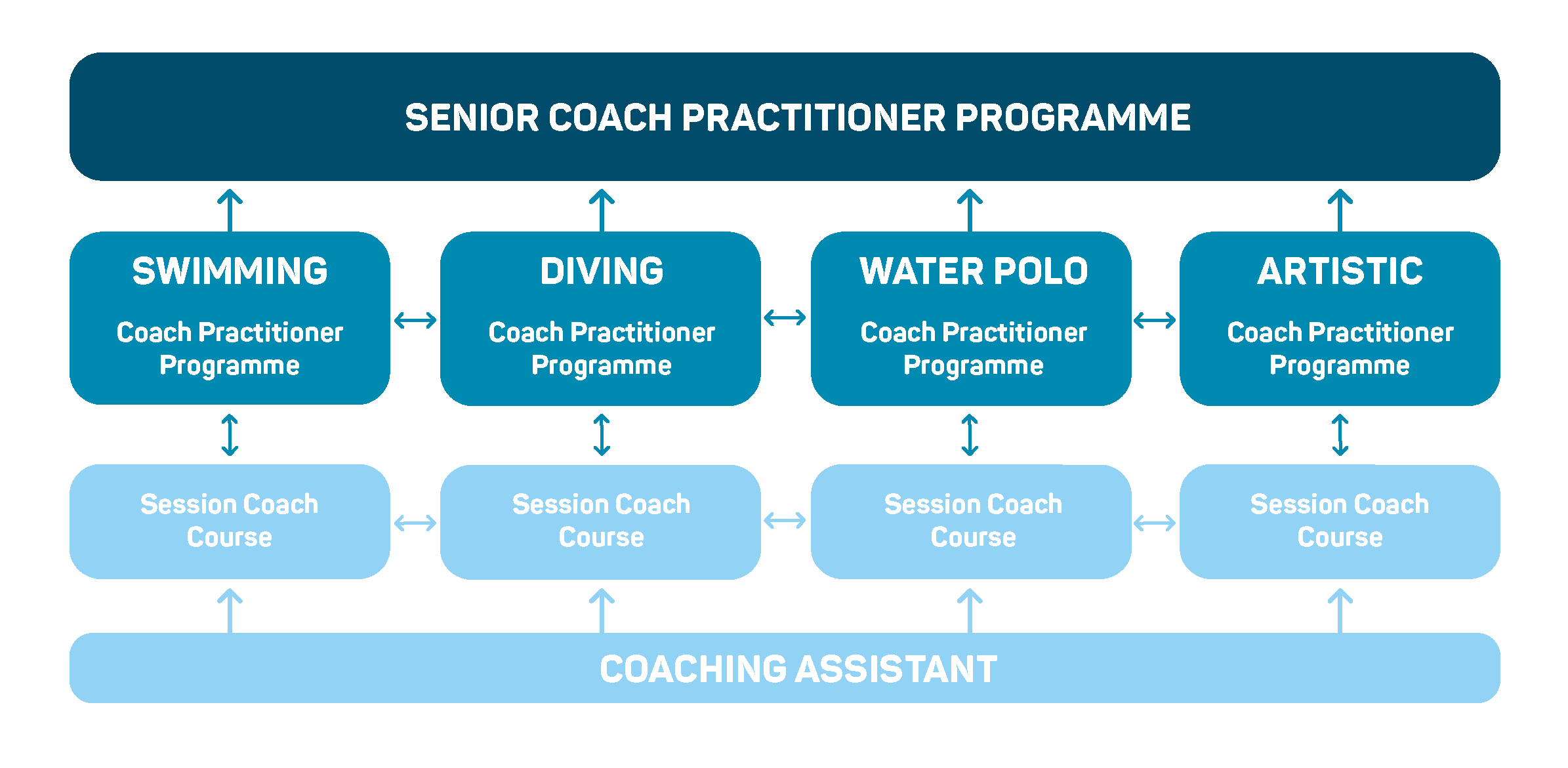
- The Coaching Assistant opportunity is designed to provide volunteers with an accessible route to assist coaches within real coaching environments.
- The Session Coach Course is designed to introduce learners to the craft of coaching, enabling them to develop the knowledge, skills, and confidence required to coach independently with the skills to continue to grow and refine their practice.
- The Coach Practitioner Programme is designed to provide coaches with a challenging, supportive, and meaningful learning experience that deepens and expands their practice. The programme aims to develop reflective practitioners who can engage effectively and ethically with the realities, responsibilities, and complexities of coaching.
- The Senior Coach Practitioner Programme is designed to offer experienced coaches a highly stimulating and transformative developmental experience. The programme challenges established ways of thinking and practicing, pushing practitioners to explore new possibilities for coaching practice and leadership. Its purpose is to develop forward-thinking practitioners capable of advancing, shaping, and influencing the future direction of coaching.
Great coaching for all
This curriculum is built on the belief that everyone in aquatics should have great coaching experience, across:
- Participation
- Development
- Performance
And across all stages of life:
- Children
- Adolescents
- Adults
Each of these contexts is different. Each requires specific knowledge, skills, and understanding.
Our aim is to support coaches to develop relevant expertise for their environment, ensuring that every participant experiences high‑quality coaching.
Session Coach Course
Build the knowledge, skills and confidence to deliver effective coaching sessions.
The Session Coach Course is a practical, hands‑on introduction to the craft of coaching, designed to help you develop the skills and confidence to plan and deliver high‑quality sessions.
You’ll learn not just what to coach, but how to coach and who you are coaching — building the foundations for effective, informed coaching practice.
Through practical experience, guided reflection, and shared learning, you will develop the ability to make confident decisions in real coaching environments.
Programme Details
- Duration: 3 months
- Learning hours: 67
- Delivery: Blended (face‑to‑face and online)
- Cohort size: Up to 12 coaches
- Discipline‑specific
- Level: Benchmarked at Level 2 (with Level 3 elements)
* This is a non‑regulated course
About the Course
The Session Coach Course introduces the craft of coaching through exploring who you are coaching, what you are coaching and how you are coaching.
It is designed to help you:
- Develop core coaching knowledge and skills
- Build confidence in delivering sessions independently
- Learn how to adapt coaching to different people and contexts
Learning is practical and grounded in your experience, with a strong focus on:
- Applying ideas in real sessions
- Reflecting on what happens
- Continuously improving your approach
By the end of the course, you will be able to deliver effective, engaging coaching sessions with confidence.
Who Is It For?
This course is ideal for new or developing coaches. It is suited to those who:
- Are starting their coaching journey
- Want to individualise and learn the craft of coaching
- Want to deliver better, more effective sessions
- Are open to learning through practice and reflection
- Want to build confidence in real coaching environments
Whether you’re completely new or have some experience, this course supports your development as a coach.
What You Will Learn
The course is built around the Who–What–How framework, helping you develop the relevant skills of coaching.
You will learn how to:
- Build caring, supportive relationships by understanding participants’ motivations, needs, and reasons for taking part
- Create positive, engaging environments that build confidence and encourage active participation
- Plan and deliver structured coaching sessions that support individual and group development goals
- Apply fundamental technical skills and principles to support learning and performance
- Use a range of coaching strategies to support learning and adapt approaches to meet individual needs
- Make informed decisions in practice and reflect on coaching to improve effectiveness over time
- Act responsibly and ethically, prioritising participant wellbeing and development
- Engage with other coaches to share ideas, reflect, and develop within a coaching community
How You Will Learn
Learning is experiential, social, and practice‑based.
You will take part in a blend of:
- Face‑to‑face learning events – develop understanding and observe coaching
- Practical coaching sessions – apply ideas in your own environment
- Learning tasks – test and adapt your coaching
- Online sense‑making sessions – reflect and share experiences
- 1:1 professional discussions – receive feedback and support
Throughout the course, you will learn by:
- Trying ideas in practice
- Reflecting on what happens
- Learning with and from other coaches
This cycle helps you build confidence and competence in real coaching situations.
Course Structure
The course is delivered over three months, following a continuous cycle of practice and reflection.
Each month includes:
- A learning event (introducing ideas and concepts)
- Coaching in practice (applying learning)
- A sense‑making session (reflecting with others)
- A professional discussion (individual feedback)
This repeated cycle helps you steadily build your skills, understanding, and confidence over time.
Apply or Find Out More
Start your coaching journey with the Session Coach Course.
Coach Practitioner Programme
Develop reflective, informed and impactful coaching practice.
The Coach Practitioner Programme is a 12‑month professional development experience designed for coaches who want to deepen their practice, challenge their thinking, and better understand the complexity of coaching.
This programme supports you to explore why coaching works, improve your coaching practice, and navigate the complexity of contemporary coaching.
Through a combination of face‑to‑face learning, real‑world practice, and collaborative inquiry, you will develop as a reflective, ethical, and self‑aware practitioner.
Programme Details
- Duration: 12 months
- Learning hours: 180–220
- Delivery: Blended (face‑to‑face and online)
- Cohort size: Up to 12 coaches
- Start dates: January and September
- Level: Notionally benchmarked at Level 4 (with Level 5 elements)
* This is a non‑regulated qualification
About the Programme
The Coach Practitioner Programme is designed to provide a challenging, supportive, and personally meaningful learning experience.
It moves beyond traditional courses by focusing on your development as a coach through:
- Reflection on your own practice
- Exploration of your coaching context and the challenges you face
- Continuous inquiry and experimentation
Learning is social, co‑created, and driven by your needs, placing you at the centre of your own development journey.
Throughout the programme, you will:
- Explore your current beliefs and assumptions
- Develop and appraise your coaching standards
- Build your skills to work with complexity
Who Is It For?
This programme is designed for experienced coaches who are ready to invest in their development. It is particularly suited to coaches who:
- Are curious and open to new ideas
- Want to understand why their coaching works
- Value learning with and from others
- Are committed to continuous improvement
If you are looking for more than a qualification - and want a meaningful, practice‑led learning experience - this programme is for you.
What You Will Learn
The programme is built around the Who–What–How framework, helping you develop a complete and integrated coaching practice.
You will develop your ability to:
- Develop a holistic understanding of participants, recognising their identities, experiences, and social context
- Build strong, reciprocal relationships and create engaging, athlete‑centred environments
- Co‑create flexible development plans with participants that evolve over time
- Apply technical and tactical knowledge to design meaningful and personalised practice
- Experiment with and adapt coaching approaches to support individual learning and development
- Develop self‑awareness by reflecting on your beliefs, values, and coaching impact
- Act ethically and use feedback to continually improve coaching practice and outcomes
- Contribute to the coaching community through collaboration, sharing, and collective learning
How You Will Learn
Learning is active, practical, and centred on your coaching environment.
You will engage in a blend of experiences, including:
- Face‑to‑face learning events – explore ideas and challenge thinking
- Real‑world learning tasks – experiment with ideas in your practice
- 1:1 professional conversations – receive personalised support and feedback
- Online sessions – reflect, share, and make sense of experiences
- E‑learning modules – provide insight and stimulus for learning
- A coaching project – investigate a real coaching problem and generate knowledge
Programme Structure
The programme is delivered over three phases, supporting your development from reflection to application.
Phase 1 – Understanding Self and Context
- Who am I and where am I coaching?
- Who am I coaching?
Phase 2 – Developing Practice
- What am I coaching?
- How am I coaching?
Phase 3 – Generating Knowledge
- Coaching project
- Project‑based learning and knowledge sharing
Each phase combines face‑to‑face events, independent learning, and supported reflection.
The Coaching Project
A central feature of the programme is your coaching project. You will:
- Identify a real challenge or problem within your coaching
- Explore, generate and test ideas in practice
- Generate meaningful insights and solutions
The focus is on creating something of lasting value through inquiry, experimentation, collaboration and reflection. Participants generate and share communal knowledge that elevates standards, strengthens the coaching profession and improves practice. This collective endeavour culminates in a celebration event where insights, achievements and contributions are shared and recognised.
Apply or Find Out More
Take the next step in your coaching journey.
Senior Coach Practitioner course
The Senior Coach Practitioner course develops coaches who operate at a very high level across all aspects of coaching. It focuses on building advanced, integrated expertise, supporting coaches to think critically, respond to complex and unpredictable situations and make well-reasoned decisions.
As leaders in the coaching community, participants also learn to mentor others, shape positive environments and contribute to raising standards across their respective sport.
This programme is still in development – more details will be shared in due course.
Coaching Assistant course
The Coaching Assistant course introduces the foundations of supporting coaching sessions. It provides a basic understanding of core coaching responsibilities, enabling assistants to carry out simple tasks with guidance while building confidence and developing their understanding of effective coaching practice.
This programme is still in development – more details will be shared in due course.
Coach Educator
The Coach Educator role supports and leads learning within Coach Education programmes by facilitating inquiry-led, practice-based development. Working alongside coaches as an experienced partner, they encourage reflection, critical thinking and context-led decision-making, helping coaches navigate complexity and continually refine their practice.
Are the existing coaching qualifications no longer valid?
Existing coaching qualifications will continue to remain valid. The new qualifications are an evolution, but coaches will still be able to coach under their current coaching remit and responsibilities.
Do we have to retrain?
Nobody will be made to retrain. The new Coach Education curriculum offers new and contemporary learning and development opportunities that coaches will benefit from.
How do the courses differ from each other?
From the underpinning philosophy to practical experience, the new coach education framework is very different. For a full explanation, please see the Coach Education curriculum framework document which lays out the changes in detail.
Why do the new courses look longer?
Learning takes time and it is vitally important that the design of any learning provides opportunity and enables space and time for people to be able make sense of new ideas and learn.
Where do current coaches sit on this new framework?
There isn’t a perfect one-to-one alignment. Coaches may currently operate across multiple areas of the framework, so individual mapping will be used to identify best fit. The framework is a guide to support clarity and development, not a direct re-labelling of existing roles.
“I have X qualification, what next?”
Progression in coaching is not solely dependent on qualifications, but within the curriculum, progression typically aligns as follows:
Assistant Coach → Session Coach
Coach → Coach Practitioner
Senior Coach → Senior Coach Practitioner.
There will also be Recognition of Prior Learning (RPL) routes, enabling experienced coaches to access different qualifications where appropriate.
How long is each face‑to‑face day?
The learning days are based on a working day. Depending on the sport, venue and opportunity available to observe coaching, learning days will be structured to suit. So, this could mean different start and finish times.
We have kept learning days in the Session Coach course to single days to accommodate other commitments and priorities.
Our coach pay rates align to qualification - where do these fit in the new framework?
Qualifications should be considered when setting rates of pay but should not be the sole factor. Decisions should also reflect role, responsibilities, experience and the impact coaches have, including the outcomes they achieve.
Ultimately, it is for employers to determine pay rates. However, what is clear in the changes is that coach education has been relevelled upward to reflect greater expertise and the real demands of coaching.
We would strongly discourage any reduction in pay based on the new curriculum and instead encourage fair recognition of the expertise coaches bring.
How does the new curriculum address the technical aspects of the sports?
We have listened to feedback from the coaching community about the importance of technical knowledge and we have carefully considered the technical needs in the new curriculum. We absolutely agree that coaches need and should aspire to a high level of technical knowledge and understanding.
We also believe the value of technical knowledge lies in helping coaches understand the participant's performance to make informed decisions and support learning, rather than simply identify and correct movement patterns.
Will my current coaching qualification still be valid?
Yes. All existing coaching qualifications will remain valid and continue to be recognised by Swim England.
Do I need to contact anyone at Swim England to update anything linked to my current coaching qualifications?
All qualification records will remain unchanged and no action is required. However when you review your membership profile and something isn’t correct reach out to [email protected]
Will I automatically be given the equivalent coaching qualification from the new framework?
No. The new programmes are not aligned directly to the existing therefore are not equivalent. As existing qualifications will remain valid and recognised, coaches will not automatically receive a new qualification under the new framework.
If you wish to gain one of the new qualifications, you can enrol on an appropriate course. Your entry point will depend on your current qualification and experience. Please refer to the qualification mapping information for further guidance.
Will the new coaching framework affect my Swim England membership status?
No. The introduction of the new coaching framework does not change any existing requirements relating to membership, licensing, safeguarding or DBS compliance.
Can I progress within the new framework?
Yes. Progression routes are available within the new framework. Your current qualification and experience will help determine the most appropriate entry point.
I am currently booked onto an existing coaching qualification. What happens now?
Any existing bookings will continue as planned unless you are advised otherwise by the training provider.
Will I be able to coach the same activities and participants as I do now?
Yes. Your current qualification remains valid, and you can continue coaching within the scope of that qualification. The introduction of the new framework does not reduce or remove the coaching permissions associated with existing qualifications.
What is a Session Coach?
A Session Coach is a coach that is capable of independently planning, delivering and reviewing coaching sessions and blocks of coaching sessions with participants and / or athletes.
Typically, they will work within a larger programme and wider support structure, but with development it is possible for them to develop the expertise to lead squads.
Their practice is emerging and developing, and they can competently engage in the core responsibilities of coaching as outlined in the curriculum framework.
They will typically focus on a particular domain of coaching such as participation, development, or performance. Although it’s possible that they work between different areas.
What are the prerequisites for attending a Session Coach course?
Learners must have access to a coaching environment and an arrangement with their club and Head Coach to prepare and deliver coaching sessions, or parts of sessions, throughout the duration of the course.
This is a core requirement, as coaches learn most effectively through doing and reflecting on their practice. Consistent access to coaching opportunities is therefore essential for full participation and development.
We strongly recommend, where possible, coaching opportunities are with the same group of participants / athletes as a trusting coach-athlete relationship is the basis of good coaching.
Additionally, coaches need to have completed or at least be registered on a Swim England safeguarding course. Safeguarding people is a core part of a coach's professional responsibilities, and coaching without awareness of safeguarding is poor practice.
Do I need to be part of a club to attend the Session Coach course?
No, as long as suitable coaching opportunities are in place with an appropriate group of participants.
If I want to do this for a second sport, do I need to attend the whole course?
We are exploring ways for coaches who have completed a Session Coach course to access the technical components of another aquatic sport, supporting the development of an additional Session Coach qualification, potentially at a reduced cost.
How long is the Session Coach course and what are the time expectations?
The course is a total of 12 weeks with sessions spaced evenly over that period to ensure it is manageable and accessible.
Can Session Coaches independently deliver coaching sessions?
Yes, Session Coaches can independently prepare, deliver and review coaching sessions and blocks of coaching sessions on their own.
The Session Coach is primarily intended to work within a wider programme; however, with further development, they may also take on longer-term planning responsibilities.
What level of participant / athlete can I lead on?
The Session Coach qualification is not restricted or focused on a particular level of participant / athlete. This should be decided through discussion with the Head Coach, Club or organisation and Session Coach themselves.
Individuals with extensive experience as a participant / athlete, or with specific experience in a particular coaching environment, are likely to be better prepared for coaching in a specific coaching context than those with limited experience in both areas.
The level of support available is also a key factor in this decision - greater support and supervision reduces the possibility of ineffective coaching and conversely if support of supervision is low, more conservative decisions need to be made.
In summary, this decision requires careful judgement to ensure the right fit for both the Session Coach and the participants.
Is a Session Coach responsible for supporting an Assistant Coach?
Not necessarily. While a Session Coach may provide guidance or support in practice, this will depend on the specific role and context. Line management or formal responsibility for others should be defined by the employer, not assumed within the framework.
Do all of my coaches need a Session Coach qualification?
No. Not all coaches are required to hold a Session Coach qualification. However, the purpose of the new approach is to support greater expertise and higher standards in coaching. Where a coach and the club would benefit from this, we would recommend they do the course.
What is a Coach Practitioner?
A practitioner is someone who engages in the practice and craft of coaching. A practitioner denotes a higher level of practice by consistently applying their knowledge and skills to deliver high-quality coaching. They have a deeper understanding of coaching and, as such, their coaching will be more sophisticated, often leading to better outcomes.
Coach Practitioners can work effectively across varied and unpredictable situations. They are reflective practitioners, integrate ideas, create solutions, engage in reasoning and adjust their practice based on what they notice in real time.
What role does a Coach Practitioner play?
Please consider the role framing within the new Coach Education curriculum which can be found in the curriculum framework when considering this answer.
A Coach Practitioner will typically plan, facilitate and evaluate coaching sessions, leading the development of a group of participants or athletes over the medium to long term.
They might play a leading role in the structure of a coaching programme, supporting other coaches and will be an emerging leader in the coaching community.
If Session Coaches can deliver sessions independently, what is the added value of Coach Practitioner?
Many, if not most professions, require years of development and significant education to consistently deliver high-quality outcomes - and coaching is no different. The Coach Practitioner level reflects this deeper expertise, where impact goes beyond delivering sessions to consistently improving outcomes over time.