 Swim England

Our Gender Pay Gap Report 2025
17 March 2025Creating a safe, inclusive and welcoming environment sits at the heart of our strategy and the culture we are building across Swim England. This includes a clear commitment to fairness in reward, ensuring that pay reflects role and contribution regardless of gender or background.
We believe all our people should be treated fairly and consistently, whatever their background or protected characteristic. We are committed to equitable pay for comparable roles and to continually reviewing our approach so that equality remains embedded in how we reward and support our employees.
In preparing this annual report, we have assessed the reward received by everyone who worked with us in the April 2025 pay month. In this month, Swim England had 296 workers who received full pay. We had an average (mean) gender pay gap of 8%, and a midpoint (median) gender pay gap of 11%. This signifies that, on average, male workers were paid 8% more per hour than female workers during the April 2025 pay period. It also indicates that the midpoint hourly rate for male workers was 11% higher than that for female workers. The change compared with the previous year should be considered in the context of workforce composition. In April 2024, the organisation engaged a significantly higher number of female contractors (148) than male contractors (67), and these individuals were included in the calculations at that time. In April 2025, self-employed contractors have been excluded as accurate hourly data is not available.
Download a PDF of our 2025 report.
Gender pay gap
| Difference between male and female | Average (mean) | Mid-point (median) |
|---|---|---|
| Gender Pay Gap | 8% | 11% |
Pay quartiles
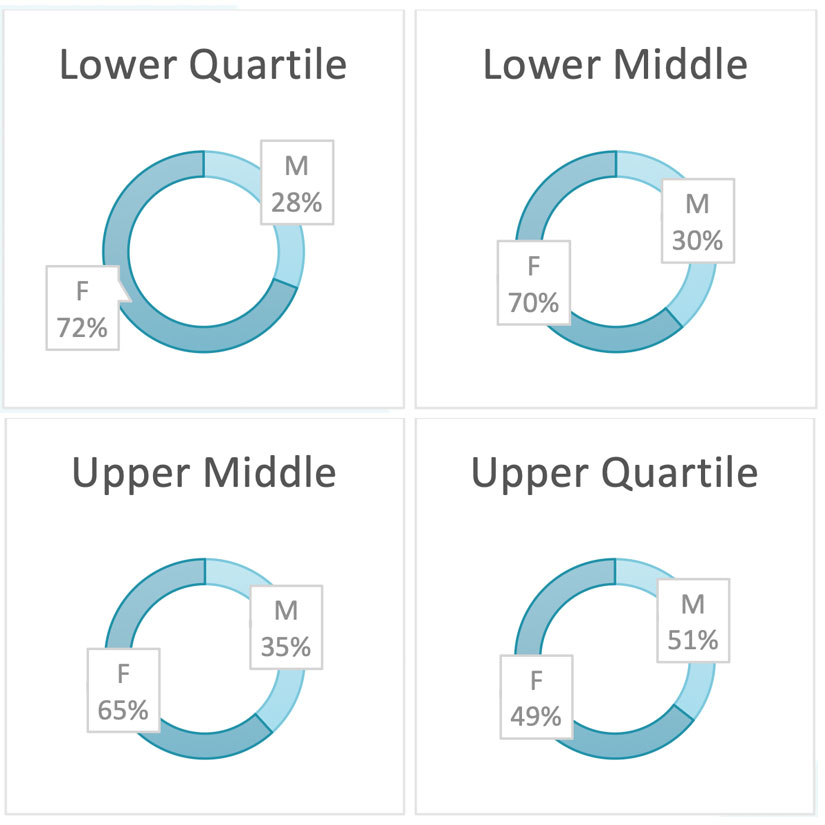
During the April 2025 pay period, of the workers’ pay, there was an overall gender split of 64% female and 36% male. These quartile graphs demonstrate the proportion of females and males in each pay quartile, with 74 workers in each Quartile.
Bonus data
Swim England does not traditionally pay bonuses, where they are paid; they are paid to our employees.
In 2025 there were no bonus payments made.
Year-on-Year Comparison
As part of the preparation of this year’s Gender Pay Gap report, we undertook a detailed review of last year’s underlying dataset and calculation methodology to ensure consistency, accuracy and comparability of reporting.
During this review, we identified two data integrity issues in the prior year dataset:
- Incorrect hourly rate – The hourly rate for one female casual employee was incorrectly interpreted as £400 rather than £75. This significantly inflated the average female hourly pay used in the mean gender pay gap calculation.
- Duplicate records – A total of 55 individuals (38 female and 17 male employees) were duplicated in the dataset, in some cases multiple times (up to nine entries per individual), with differing hourly rates recorded across those duplicate entries. This resulted in a distortion of both mean and median pay calculations.
These errors were not identified at the time of the original submission and have now been corrected as part of our strengthened data validation process.
Last year, we reported a gender pay gap of 2% mean and 0% median. Following correction of the data errors described above, and applying consistent methodology, the prior year figures would have been materially different.
For transparency, the recalculated prior year figures are:
- 10% mean and 7% median (excluding contractors, consistent with this year’s methodology)
- 8% mean and 10% median (including contractors, with duplicates removed)
The most material impact on the originally reported figures was the incorrect £400 hourly rate entry, which artificially reduced the reported mean gender pay gap by inflating average female pay.
In addition to correcting the data errors, this year we have excluded contractors from our gender pay gap calculations. This change has been made because contractor pay data was not considered sufficiently accurate or consistent for inclusion. To enable a like-for-like comparison, we have recalculated the prior year data on the same basis (excluding contractors), as outlined above.
When compared to the originally published figures (2% mean, 0% median), this appears to represent a significant increase. However, when compared to the corrected and methodologically aligned prior year figures (10% mean, 7% median excluding contractors), the year-on-year movement is more moderate and reflects normal workforce composition changes rather than a substantial deterioration in pay equity.
Following this review, we have strengthened our internal data validation, reconciliation and quality assurance processes in relation to gender pay gap analysis. We have updated our submission to the Gender Pay Gap service and republished our 2025 report.
We remain committed to transparency, continuous improvement in data integrity, and addressing the underlying drivers of our gender pay gap.
Action and Commitment
Our gender pay gap is influenced primarily by workforce composition and the distribution of roles across the organisation, rather than differences in pay for comparable roles. As a smaller organisation, changes in senior appointments and workforce structure can have a noticeable impact on annual figures. During the April 2025 snapshot period, several senior female appointments had not yet commenced, which contributed to the reported gap.
We are confident in our approach to equal pay. Swim England operates a structured pay framework supported by independent job evaluation, ensuring roles of comparable value are graded and rewarded consistently. All roles are assessed within this framework and reviewed where responsibilities change.
Our senior leadership team reflects a balanced gender profile, and we continue to see variation across role types and levels that is consistent with wider sector trends. We recognise that representation within pay quartiles may fluctuate year to year and we therefore focus on monitoring patterns over time rather
than single year movements.
To support fairness and transparency, we will continue to:
- benchmark roles through the Sport’s National Governing Body Pay Club
- review starting salary positioning and pay progression decisions
- monitor representation across pay quartiles and senior roles
- maintain a structured grading framework and independent job evaluation
- review our reward approach as part of our broader people strategy
As a Real Living Wage employer, we remain committed to ensuring all workers receive a fair rate of pay and to maintaining transparent reward practices that support attraction, retention and development across the organisation.
Progress in this area will continue to be measured through our Diversity and Inclusion Action Plan and supported by clear communication and workforce engagement.
- Download a PDF of our 2024 report.
- Download a PDF of our 2023 report.
- Download a PDF of our 2022 report.
- Download a PDF of our 2021 report.